If your planning on making the trip from Laos to Vietnam via the Na Maew/Nam Xoi border crossing on a bus here's a snippet of advice. It is possible to take a long direct bus from Vientiane to Hanoi but if you'd like to visit Phonsavan, the plain of jars, Sam Neua and Vieng Xai on the way and break up the journey a bit it is possible to take a bus from Sam Neua to Thanh Hoa or Hanoi. The bus is technically destined for Thanh Hoa but seems to generally continue straight on to Hanoi however . . . if you buy a ticket on the bus all the way to Hanoi you will likely be ripped off! The ticket from Sam Neua or Vieng Xai to Thanh Hoa is 180,000 kip, and my bus driver claimed it would cost me a further 300,000 dong (150,000 kip) to stay on the bus to Hanoi, apparently this is a frequent occurrence and the ticket from Thanh Hoa bus station to Hanoi will only cost you 80,000 dong. So get off the bus in Thanh Hoa and buy another ticket for another bus to Hanoi, the timetable claims they depart every 15 minutes but this is always subject to how many people are on the bus. If you overnight in Vieng Xai walk to the main road from the village and you will be able to flag the bus down here at around 8.30am (but you'll probably be waiting till 9.30 so if you're a little late don't assume you've missed it).
When I finally get on the bus at 9.45 we make a dash for the border which closes at 11.30. The driver is smoking something from a pipe which isn't just tobacco and doesn't smell like marijuana. He's bombing it hell for leather down the narrow mountain road flying through villages sending children and pigs squealing from his path. The bus emits an almost constant wail from it's horn under the hand of our invincible driver who seems to think any incident is impossible if you 'announce' you're coming and put your foot to the floor. I never the less make it to Thanh Hoa eight and a half hours later and through some of the most stunning scenery I've seen on this trip.
Thursday, 15 March 2012


Wednesday, 14 March 2012
Hue; Tombs, Pagodas and Palaces

The city of Hue is home to a Unesco world heritage listed ancient citadel and many tombs and pagodas of historical interest. After fending off numerous cyclo drivers who followed me around pointing me in the wrong direction and telling me the citadel was closed for lunch (it wasn't) I begin my exploring at the citadel, including the imperial city with the royal accommodations, and the king's private forbidden purple city. It is encircled by a tall imposing wall the entrance of which is a grand structure with a viewing platform from which the royals used to watch outside festivities and entertainment. It's a relatively sizable area and I spend most of an afternoon exploring it's mostly restored (though some entirely destroyed by war) pagodas, palaces, and living quarters of the royal family.
I take a city tour to discover the rest of the city's ancient and more distributed sights. After viewing a disappointing mandarin house we struggle through a sea of school children to see Thien Mu Pagoda which is quite a beautiful structure set in tree lined gardens overlooking the river. Unfortunately the cheap tour has rendered me with a useless guide who feels little need to tell us anything about the sights we are visiting so I learn very little about our next stop; Khai Dinh Tomb.
 I find it to be a beautifully dark and Gothic structure. The inside of the main building is decorated with the most elaborate and stunning ceramic mosaics and bass-reliefs, where emperor Khai Dinh combined European and Oriental influences.
 Tu Doc tomb is the largest in Hue and is the last stop on the tour. The site encompasses many beautiful archways, columns and buildings which are showing the years that have passed and beginning to sag and crumble. Unlike many of Hue's ancient site's it seems to be mainly un-renovated and therefore maintains more of it's original charm.
Hue is a city well worth spending a couple of days exploring to learn a little of it's ancient history and imagine yourself transported into the past.
Monday, 12 March 2012
Where The Troops Were Hiding in Vieng Xai
 Vieng Xai is a beautiful little village in the Hoahphanh province of Laos. Peppered with small fields and paddies it hides a dark history within the craggy limestone outcrops which wall the village. This is known as the birthplace of Lao PDR because during the Indochina war 20,000 Pathet Lao's (of the revolutionary movement) lived in a hidden city here. Dwelling in caves which riddle the cliffs they created a bomb-sheltered community hosting schools, markets and hospitals inside the depths of the caverns. The leaders of the Pathet Lao discovered and retreated to the safety of the caves from 1964-1973 while Laos was being subjected to 2 million tons of falling bombs. The US were targeting the Hoahphanh province as part of their efforts to stop the Ho Chi Minh trail and supplies getting into Vietnam. Meanwhile the Pathet Lao were fighting their own war with the government.
Some of the caves are now open to visitors and as i venture inside the cave of President Kaysone Phomvihane I am struck by the cold grey concrete-reinforced walls and damp stale air. I sense little comforts would have been afforded here. A few books from a personal library remain but but for a leaders quarters the outlook is bare. For the rest of the hidden city's inhabitants, in far more crowded conditions the darkness must have been suffocating, whilst at the same time the thick surrounding rock provided comfort by protection.
 The tour leads us through some more leaders' caves, a barren hospital cave an artillery cave with an advantageous outlook and finally to Xanglot cave. This large open-ended cavern was the host to many weddings, festival celebrations and a weekly movie screening which surely helped enliven morale during some bleak times for those trapped here. Their shelter was almost a prison; daylight locking them inside, while under the cover of darkness they dared venture out to tend crops and gather supplies. It's a fascinating tour of a hidden past. Standing in th village i could never imagine such terror ravaged this landscape or that an entire community could have hidden in the tunnel ridden rocks surrounding me. But they did and they eventually won their war and their freedom.
Sunday, 11 March 2012
Longing for the Sunshine in Halong Bay
 Visiting Halong bay when the skies are grey and droplets of water fill the air is certainly not the best time to say the least. But the weather is what it is and I don't want to miss the natural heritage listed site although my first glimpse of Halong's famous limestone islands is through a misty grey screen; somewhat mysterious but mostly miserable.
 I spend one day on a junk boat cruising around the bay and visiting various sites. Our first stop is Thien Cung cave which turns out to be an impressive, huge cavern filled with giant stalactites and columns illuminated by various coloured neon lights. It's a fabulous grotto well worth the visit. Cruising through Halong Bays notorious scenery we pass bold islands rising from (not quite so) emerald waters on the way to a floating fishing village where we stop for a short kaya
 k. After spending a night on the boat in the bay we dock on Cat Ba island and disembark for the land-based section of the trip. We are abandoned by our useless guide; mister Tom at Cat Ba national park where we climb an incredibly muddy and slippery viewpoint from which we can see nothing but the surrounding cloud! After checking into a disgusting hotel the afternoon is spent exploring Cat Ba town and beaches in the ensuing drizzle. The harbor is filled with colourful fishing boats and the scene might be quite picturesque in some warming sunshine.
After a night spent on the island we return by boat to Halong city, and then by bus to Hanoi.
Tuesday, 6 March 2012
The Mysterious Plain of Jars
The countryside surrounding the town of Phonsavan is home to some very ancient stone jars, which sporadically litter the land at many different sites and no one truly knows what their purpose was or how they came to be here.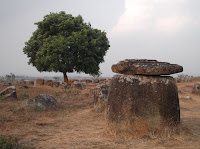 I visit site one of The Plain of jars, as it is known, with the most jars and (I have to disagree with lonely planet) a lovely hillside setting. There are several different theories on what the jars were used for and there is no evidence to verify any of them. The locals will tell you that a King created them to store Lao Lao (local whiskey) after a victorious battle while academic studies have concluded that they were funerary urns. To me neither of these explanations seems satisfactory but I can’t imagine realistically what their purpose could have been. Some of them are very large and they seem to be scattered so randomly across the landscape. Only one jar at this site remains with a lid although my guide Ponsai tells us that all had
  them but most were destroyed during the bombings. How tragic that this fascinating historical site also fell victim to the brutality of war. Most of the area here has been cleared of UXO (unexploded ordnance) by MAG who have marked out safe paths but craters from past explosions are still visible very close to the jars. The plain of huge stone urns is almost other-worldly and I imagine fairytale giants sitting on a hillside and gulping from the heavy containers before discarding them on the ground. In a dream world.
 I visit site one of The Plain of jars, as it is known, with the most jars and (I have to disagree with lonely planet) a lovely hillside setting. There are several different theories on what the jars were used for and there is no evidence to verify any of them. The locals will tell you that a King created them to store Lao Lao (local whiskey) after a victorious battle while academic studies have concluded that they were funerary urns. To me neither of these explanations seems satisfactory but I can’t imagine realistically what their purpose could have been. Some of them are very large and they seem to be scattered so randomly across the landscape. Only one jar at this site remains with a lid although my guide Ponsai tells us that all had
  them but most were destroyed during the bombings. How tragic that this fascinating historical site also fell victim to the brutality of war. Most of the area here has been cleared of UXO (unexploded ordnance) by MAG who have marked out safe paths but craters from past explosions are still visible very close to the jars. The plain of huge stone urns is almost other-worldly and I imagine fairytale giants sitting on a hillside and gulping from the heavy containers before discarding them on the ground. In a dream world.
Phonsavan; Discovering The War
After a hellish twelve hour ride from Vientiane we pull into a provincial bus station after 8 am and I am more than elated to step into the cool fresh air of Phonsavan, as a lone traveler. Stepping out into the dusty streets I find it not to be a glamorous town or even very attractive but it has a warm outback feeling to it and I spend the day wandering its streets and markets.

Having heard a little of the dark history of this region I pay a visit to MAG; Mines Advisory Group to learn more. Mag is an organization working in Laos to clear UXO (unexploded ordnance) i.e. bombs that were dropped during the war, from land particularly which is useful to communities. It is estimated around 30% of the 2 million tons of bombs dropped on Laos during the second Indochina war did not explode on impact leaving them littering the country; from farmland to temples to school yards. I am amazed to discover that Laos is the most bombed country in the world (per person).
They call it ‘the secret war’ and I find myself engrossed discovering the history of the soil I stand upon even more so because its effects are still destroying lives today. Hundreds of people are still being maimed, blinded and killed by bombs they disturb both accidentally; perhaps while ploughing a field, and purposefully; to sell the metal for scrap. Many of the victims are children who search for scrap metal to support their families or innocently pick up a colourful ball-like cluster ‘bombie’.
MAG are on an inspiring mission to clear land of hazardous 'bombies' to make it safe for farming, developing and simply living on so some of the poorest communities may have a hope to help themselves and rise from the ashes of somebody else’s war. So innocent lives do not continue to be lost more than 3 decades after the country was carpeted by the deathly showers.
I’m so fascinated by what I learn that I go to a local restaurant which is screening a documentary where I learn more about the actions of the USA and CIA whose covert operations in Laos were hidden behind a smokescreen of humanitarian aid. All the while their agents worked with a general Vang Pao to train a secret army of Hmong fighters to battle communism in the country. The following day I visit some large bomb craters which scar the land as stark reminders of the power of the bombs, some of which still lie in wait. A large portion of the land at the crater site has been cleared of UXO but not all of it and my guide shows me a 'bombie' from a cluster bomb which idly lies half buried in the dry soil. It’s quite shocking to see and really emphasizes the everyday dangers that the people who live here face. I’m instilled with the deepest sympathy for the country I am in which is still suffering from a waged war and suffering in silence from the rest of the world.

Having heard a little of the dark history of this region I pay a visit to MAG; Mines Advisory Group to learn more. Mag is an organization working in Laos to clear UXO (unexploded ordnance) i.e. bombs that were dropped during the war, from land particularly which is useful to communities. It is estimated around 30% of the 2 million tons of bombs dropped on Laos during the second Indochina war did not explode on impact leaving them littering the country; from farmland to temples to school yards. I am amazed to discover that Laos is the most bombed country in the world (per person).
They call it ‘the secret war’ and I find myself engrossed discovering the history of the soil I stand upon even more so because its effects are still destroying lives today. Hundreds of people are still being maimed, blinded and killed by bombs they disturb both accidentally; perhaps while ploughing a field, and purposefully; to sell the metal for scrap. Many of the victims are children who search for scrap metal to support their families or innocently pick up a colourful ball-like cluster ‘bombie’.

MAG are on an inspiring mission to clear land of hazardous 'bombies' to make it safe for farming, developing and simply living on so some of the poorest communities may have a hope to help themselves and rise from the ashes of somebody else’s war. So innocent lives do not continue to be lost more than 3 decades after the country was carpeted by the deathly showers.
I’m so fascinated by what I learn that I go to a local restaurant which is screening a documentary where I learn more about the actions of the USA and CIA whose covert operations in Laos were hidden behind a smokescreen of humanitarian aid. All the while their agents worked with a general Vang Pao to train a secret army of Hmong fighters to battle communism in the country. The following day I visit some large bomb craters which scar the land as stark reminders of the power of the bombs, some of which still lie in wait. A large portion of the land at the crater site has been cleared of UXO but not all of it and my guide shows me a 'bombie' from a cluster bomb which idly lies half buried in the dry soil. It’s quite shocking to see and really emphasizes the everyday dangers that the people who live here face. I’m instilled with the deepest sympathy for the country I am in which is still suffering from a waged war and suffering in silence from the rest of the world.
Sunday, 4 March 2012
The Triumph of Tubing: Vang Vieng

So we’re doing what Vang Vieng is famous for; Tubing. For those who haven’t heard of this anomaly let me explain. You hire a rubber ring, along with hundreds of eager ignorant young people clad in bikinis and souvenir high-vis t-shirts, and head in a tuk tuk to the river, upstream of VV. Everyone is deposited at the starting point and left to float the two hour stretch of river back to town, only to spice things up a bit the river bank is covered with bars blaring pop dance music, very keen to sell you copious amounts of alcohol in little plastic buckets and dishing out free whiskey shots. So we spend a few hours in the waterside bars drinking merrily and occasionally floating to a different bar, well one with a different name but same music and same buckets! It’s a little strange and I wonder how this juxtaposition of natural beauty and alcohol induced mental party place ever came to be. SPLASH, what’s that? A flailing body plummeting into the river from one of the many zip lines, slides and swings the bars have arranged for their inebriated patrons. Some of which have actually caused sad and notorious backpacker deaths. Drunk youths + rubber rings + river always seemed a recipe for trouble to me. With the sun disappearing behind the mountain the river air begins to chill, running out of time to make it back to town I abort the mission on the first day and sneak away in a tuk tuk back to town. On the second day we decide to try and float the whole distance back to town. At lunch time we stop at a bar where a dear old lady, who seems to be running the place single handed, is dishing out free chili fries with every drink. She looks so incredibly out of place it’s sweet, but she clearly isn’t intimidated by her drunken clientele. Around 4.15 after stopping at a bar where another old Lao lady is dancing around the youths very endearingly we grab our tubes and make a move for home. So we’re floating down the river, not really sure how long it’s going to take, so we’re paddling, paddling, paddling. . .the river meanders past the limestone cliffs, through the shaded valley and past a few more spartan bars. One and a half hours later of paddling and a couple of the girls give up, while Richard and I are determined to reach the bitter end. Two kilometers later and past a small herd of bathing buffalo we finally arrive back in Vang Vieng, hurrah! The evenings here are similar to the days with the same crowd continuing a never ending party. We head to the bucket bar where, you guessed it, free buckets before 10! Are you kidding it’s like the people of Vang Vieng have made it their mission to seriously intoxicate every single backpacker that comes this way, regardless of profit! All I can say is this whiskey must be very cheap!
Subscribe to:
Posts (Atom)