Thursday, 29 March 2012

River life in Can Tho; floating markets


I have arranged a homestay with Mr Hung who lives in a village called Thuong Thanh in Can Tho. Can Tho is in the south of Vietnam, in the Mekong Delta where life slowly revolves around the river. Mr Hung’s house is set right next to the river and he’s built some little wooden bungalows for his guests to stay in.
It’s idyllic. We are cooked the most delicious elephant ear fish (the local specialty) lunch by Hung’s family, after which we borrow some bicycles to traverse the riverside village’s paths, which are over hung by numerous fruit trees and flowers; mangoes, jackfruit, bananas and coconuts abound along with rose apples and star apples. It’s a beautiful setting and such a warm atmosphere; everybody waves hello as we cycle by and at one school a whole class stands up in their classroom, waving and squealing ‘hello hello hello’! I feel special.
After a restless sleep listening to the ‘tranquil’ sounds of the river; dogs
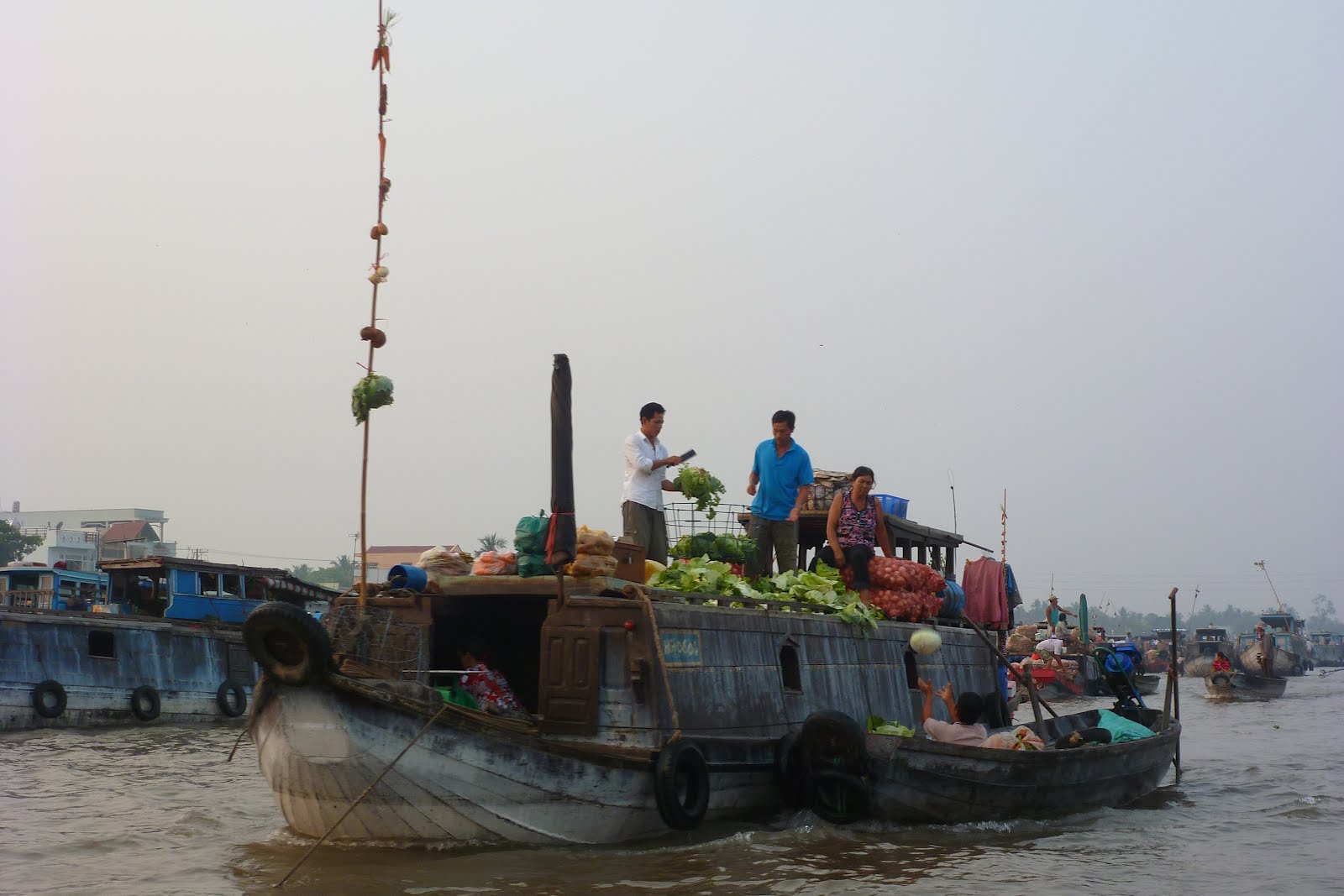
barking, chickens squawking and geckos chirping, I rise just before 6 to visit Cai Rang floating market with Mr Hung. Many tourists come to see the famous floating
markets of the Mekong but we’re early enough not to run into them although it’s still very lively. Farmers bring their produce here to sell to traders who carry it out to the surrounding villages and towns. There’s large boats filled to the brim with all kinds of fruit and vegetables; pineapples, potatoes, pumpkins, yams, turnips, carrots, watermelons. . . the list is endless. The sellers tie a sample of their produce to a long pole extending above the boat to advertise what their selling and traders paddle around them filling their longboats with a selection of fruit and vegetables to sell on. It’s a fascinating scene and the river looks alive and magical in the early morning sunlight. Mr Hung also takes us on a tour to visit a rice noodle factory, a vegetable seedling nursery, a watermelon farm and a rice factory. We get a glimpse of everyday life in the Mekong delta and it’s fabulous. All the people seem so content in their simple work, they are humble and happy. They also make you wonder if a life like this isn’t better than one in a big city where banks and new shoes and offices rule the day. Mr Hung charges $12 a night at his homestay including dinner and breakfast. It’s more for the personal tour but it was definitely worth it! You can make a booking with him directly at hunghomestay@yahoo.com.vn or on 84903849881.

Monday, 26 March 2012

Ho Chi Minh City; The Cu Chi Tunnels

About thirty kilometres from the city of Saigon lies the beginning of an amazing network of tunnels consisting of 250 kilometres of underground passageways. They were created during the wars by guerillas to obtain refuge from falling bombs and raining chemicals. The first tunnels were dug during the French invasion and occupation but during this time only one level was created and during the US invasion two further levels were dug out creating a three tiered warren with sleeping quarters, meeting rooms, kitchens, fresh water wells, air vents and escape routes. We take two local buses to get to the Ben Duoc tunnel system and it takes a good two hours but only 12,000VND.
After buying an 80,000vnd ticket I am led into the woods in a small group by a guide who first shows us the outlet to an air vent which is cleverly disguised as a termite mound. He then leads us to a patch of ground where he brushes away some leaves to reveal a small manhole cover which hides one of the original entrances to the tunnels. Its a very small rectangular gap in the ground and feels instantly secret and slightly claustrophobic as we test out descending our over-sized bodies into the tunnel. We have to turn diagonally and raise our hands above our heads just to fit in the hole. It's quite a shock. We stop next at an underground surgery and operating theatre, the ceiling of which has been removed for ease of viewing. The guide shows us some booby-traps; leaf covered pits full of sharp spikes intended to maim US soldiers who strayed too close. They give me tingles down my spine. We descend below the earth into a short section of tunnel. I read that the tunnels have been widened for larger tourists to fit in but they're still very small and you have to crouch, almost crawl, through them. There are some bats hanging from the tunnel roof which suprises me due to the amount of human activity through them. You inevitably bump into them given the lack of room and send them frantically fluttering around your head. After emerging into a meeting room we make a further excursion 30 metres through the depths of the tunnels where the ceiling gets lower and the claustrophobic pressure increases.
The tunnels have already withstood the test of hundreds of bombs and don't look like collapsing any time. The ground here is very hard and the men who dug the tunnels could sometimes dig no more than 2 metres a day. It took 20 years to complete the 250 km network.

Saturday, 24 March 2012

Ho Chi Minh City; The War Remnants Museum

Outside the War remnants museum in Saigon stand some imposing warfare vehicles and planes. They loom over you casting a dark shadow and a certain sense of impending doom. The first exhibition I enter is outside and is a graphic depiction of conditions in prisons where POW's were kept, including the 'tiger cages' where inmates were enclosed in tiny cages of barbed wire and forced to suffer; enduring punishment and starvation. My stomach turns as I read descriptions of torture treatments the prisoners were subjected to. Removing prisoners toe nails and finger nails. There's a room with a guillotine. Burning sex organs. There's a dark, damp cell. Breaking knee-caps off. How could anyone be so desensitized to commit these acts? Burying prisoners alive. I make my way into the building under a dark cloud and up the stairs a world of terror, death and despair unfolds before my eyes through images from war photographers.
"Platoon 1 led by Lieutenant william Colley overwhelmed to seek for civilians with the aim of killing anyone they found. Particularly at a ditch they found at the other end of Thuan Yen hamlet. The U.S. troops massacred 170 people". Black and white prints of agonised faces cover the walls. Screaming babies. Dead bodies. "most were women and babies. It looked as if they tried to get away". An image shows a bloody heap of female bodies, some tiny, all helpless. Skin melted from bodies like chocolate dripping off a candy bar. "Victim of phosphorus bombs" it simply reads.
The next area is an exhibition of the 'Agent Orange aftermath'. "The US air force sprayed 72 million litres of toxic chemicals of various types on Vietnam, including 44 million litres of Agent Orange". Agent Orange was sprayed over the land with the aim of defoliating plants and crops and destroying food and water resources. The hideous chemical also had the effect of directly harming people causing illnesses and cancers and destroying DNA causing future generations to be born with terrible malformations, birth defects, diseases and brain problems. Limbless children. Tumoured faces. Desperately sadly deformed bodies. The US came. They tried to destroy lives. They succeeded more than they even knew. In the streets of Saigon I see the crippled bodies, I see the desperate faces, I see their agony, their need, their sadness. Why are they sitting on the streets? A hand raised for any donation. Someone should be paying for this. The museum makes me feel sick. I walk around and see dismembered bodies, burnt faces, blood, pain, terror, dead babies, mothers, pregnant women. A lump in my throat. Soldiers, guns, burning villages. What is that look in his eye? A knot twists in my stomach. How did these men look into the eyes of their victims. The innocent. The slaughtered. Fight an army not a child.
The museum is one of the best I've ever been to and I leave feeling terrible. A must see.

Friday, 23 March 2012

Mui Ne; Almost Arabia

Set on the coast amid rolling sand dunes, the town of Mui Ne seems a world away from the rest of Vietnam. I said town but it’s really just a tourist resort although there is a close-by fishing village which supplies some delicious fresh fish to the tourist restaurants which is super tasty. I visit both the red and white sand dunes on a tour on my first afternoon in Mui Ne, their undulating forms dominate sections of land and standing in the centre I’d like to say you feel like you could be lost in the middle of the Sahara but you can see either a lake or the ocean from both so that would be misleading. They’re not quite as impressive as I’d imagined but quite a sight none the less and very different from any other landscape I’ve seen in the country. The tour also takes me to a spot dubbed ‘the fairy spring’; a stream which runs alongside a section of the dunes where red and white sands create some colourful formations. It’s actually the highlight and more beautiful than the star dunes. I also borrow a bicycle one morning to cycle to a couple of old Cham towers which stand atop a hill, they're well preserved and with the view from the hill rewarding enough for my cycle. Mui Ne has little else to offer the average traveller it’s more of a two week tourist destination for holidaying Russians, although the beach is nice enough to spend an extra day relaxing here and gorging on the freshest seafood!

Thursday, 22 March 2012

Ninh Binh: In One Day

I was planning to stay overnight in Ninh Binh but after taking a morning bus from Hanoi I've arrived early enough to see the attractions in an afternoon, a very helpful hotelier tells me. He's keen to sell me some transport and as he suggests I tour on a mototaxi for the afternoon and then take the night bus to Hue, I think why not?
I am driven first to Tam Coc, apparently often referred to as 'Halong Bay on the rice paddies' because of it's similar stunning limestone karsts. I take a trip up the river in a small boat which the boatman seems to put all of his effort into rowing, but I suspect it's a bit of a show in an attempt to get a bigger tip! The cliffs rise high above the the little paddies of bright green shoots while a small river picturesquely meanders it's way through the midst of this stunning scenery. The river, along with us in our little wooden vessel, passes through a few dark caves, which these very waters no doubt created, with ceilings so low I have to duck to avoid stalactites appearing from the darkness. I am returned to my moto-driver empty-handed after two hours even though I've been told to buy everything from souvenirs to a drink for my boatman, even the boatman himself tried to sell me some embroidered textiles!
It's a cold, grey day and as we drive through the countryside to Hoa Lu the wind goes straight through my thin cardigan, brrr. Hoa Lu is an ancient citadel created during one of the chinese dynasties but mostly destroyed or crumbled to pieces. I explore the two remaining temple pagodas which are quite architecturally aesthetic but there's nothing very special to be seen.
Ninh Binh is well known for it's local delicacy of goat meat, having seen some mountain goats precariously perched on the cliffs of Tam Coc I am keen to try the local favourite so I order a goat meat bbq in the town. It's in a delicious marinade and is very tasty. I'm glad I only stayed for an afternoon, with the boat trip and my goat dinner I've had the best Ninh Binh has to offer.

Wednesday, 21 March 2012

If You're Booking a Halong Bay Tour. . .

Just a suggestion if you are booking a Halong Bay tour; I booked on to a standard 3 day tour from Hanoi, standard meaning cheap and budget, as opposed to the more expensive deluxe and superior tours which I figured would be very similar. I think it's safe to say you get what you pay for with a Halong Bay tour; the boat was lovely but the hotel on Cat Ba was very mouldy (including my pillow) and all the food was tasteless and in very small portions, the guide also did no guiding whatsoever and might as well not have been there. So if you're going to be happy with this take the cheap option but I would recommend paying just a few more dollars to not be hungry and not wake up with nostrils full of fungus smell!

Tuesday, 20 March 2012

Dalat; Not For Honeymooners


After a four hour drive from Nha Trang I am disappointed by my first sights of Dalat, I was expecting a mountainside town reminiscent of the green farmland of Malaysia’s Cameron highlands, instead all I see is plastic polly-tunnels and greenhouses overcrowding the land so barely a patch of green remains visible. The town itself is a huge concrete urban area with little to please the eye but a few swiss-mountain style buildings. Apparently many locals like to come here for their honeymoon, though it is beyond my comprehension why anyone would do such a thing. I see nothing romantic about the place what so ever, even the plastic swan paddle boats on the lake seem too tacky to be remotely charming.
Having heard of the legendary easyriders of Dalat; a group of motorbike drivers who run day (and longer) tours of the area, I decide to see if they can help occupy my afternoon in Dalat. I’m expecting some kind of leather-clad biker group but on entering their office/hangout I am greeted by a friendly, old guy. Greying and weathered he has the kindest face and is really helpful, even though I don’t have enough time to do a tour he arranges a moto taxi to run me about to some attractions for a few hours. Most of Dalat’s tourist sights are Asian-orientated tacky and attractions, which I visit the least crappy of! I go first to a beautifully peaceful meditation centre set on a hillside surrounded by beautiful gardens, then to Datlana waterfall where some genius has created an odd rollercoaster luge ride which I don’t go on. We make two more stops in the town at an old railway station and the ‘crazy house’ a quirky funhouse you might find in Disneyland. Cheesy! I do not think Dalat is worth a visit unless you’re planning to do an easyrider tour to it, around it or away from it.