Showing posts with label Cambodia. Show all posts

Saturday, 21 April 2012

Sen Monorom; Elephant Valley Project


The reason most tourists seem to be in Sen Monorom, including us, is to visit the Elephant Vally Project. A project set up by an Englishman; Jack to rescue abused and injured working elephants and provide them with a safe natural environment where they can live out the rest of their days. Jack rents the jungle land from local farmers and brings the Elephants here either by buying them from the owners or by renting them on a long term basis to keep them out of work. The elephants are then free to roam, bathe and feed as they please in the valley. Each elephant still has a mahout to keep an eye on it for the safety of visitors and to stop them straying into surrounding cropland which would cause conflict with the local farmers.
>We begin our visit walking down into the valley to watch Bob and his girlfriend Onion having their morning bath and mud-covering session in the river. After them four other elephants come down, skip the bathing and go straight for the mud! It's amazing to watch them in a natural environment, just doing what they do, spraying mud and water everywhere and rubbing everything into the muddy bank. They're so close but seem so wild it's a magical experience. They spend most of the morning wallowing, even when the mahouts tell them to go and eat, they ignore them; happy in their mud bath. Eventually they wander out and make their way to some good scratching tree trunks. We walk alongside them and laugh as they bend trees right over scratching their heads, bums and trunks against them. We follow them into the forest for a while under the spell of their charm until it's time to return to camp for lunch.
After a delicious lunch we make our way, with Jack, into the second valley which is home to four more elephants and we find them also enjoying a good soak in their own muddy river. We spend the afternoon watching them while Jack tells us their stories. They are entrancing to watch and none of us wants to leave them at the end of the visit. At least they now have a nice home after their hard lives and if people keep visiting hopefully Jack can rescue the rest of the mistreated elephants in Mondulkiri.

Thursday, 12 April 2012

Siem Reap: The Temples of Angkor


I don't know where to begin this post, there's so much to say and so little that can be said with words. The Angkorian temples at Siem Reap, the most famous of which being Angkor Wat, are something which one really must experience for oneself to have any understanding of their impression. I spent 3 days exploring them and they really are stunning. I'd heard before going that if you think you'll get 'templed out' you won't. Well I think that depends how much you like old crumbly temples but it certainly won't happen as soon as you'd expect. There are so many differences in the size, shape, style, decoration and ambience of all the temples that the variety provides for almost endless interest.
Face of the Bayon


I started at the Bayon, one of the most impressive sites with it's huge carved faces looking out protectively over the lands. A massive jigsaw puzzle, the Bayons huge stone bricks lay in rows on the surrounding grass. The structure itself towers above me, exuding power and as we climb it's terraces the many all-seeing faces carved into the towers seem even more imposing. With many intricate carvings and bass-reliefs the Bayon occupies my curiosity for quite some time.
The Baphuon


The Baphuon is another favourable site and although almost as large and imposing as the Bayon, it's not as intricately decorated. It does provide a surprise in the form of a giant reclining Buddha hidden in the curves of the back wall.
I sneak past some slumbering caretakers around the Kleang and Prah Pithu, this must be the napping area!

Banteay Srei is possibly the most beautifully embellished temple of Angkor. The carvings are so intricate and delicately crafted I wonder at how long such craftsmanship took to complete. It is known as the temple of women because they say its carvings are too beautiful to have been designed by men. It's certainly very different from the other temples and worth the long ride out of town.
Ta Prom Trees
Possibly my favourite site; Ta Prom is an atmospheric gem. It is here they filmed for Angelina Jolie's tomb raider movie and I can see why. It's crumbling walls are supported by, encased in and destroyed by huge trees whose roots have chosen its stones as the place to begin their journey. Over time they have grown into monstrous plants forming a beautiful juxtaposition between nature and humanity. The overgrown jungle creates a lost world feeling amongst the crumbling ruins.
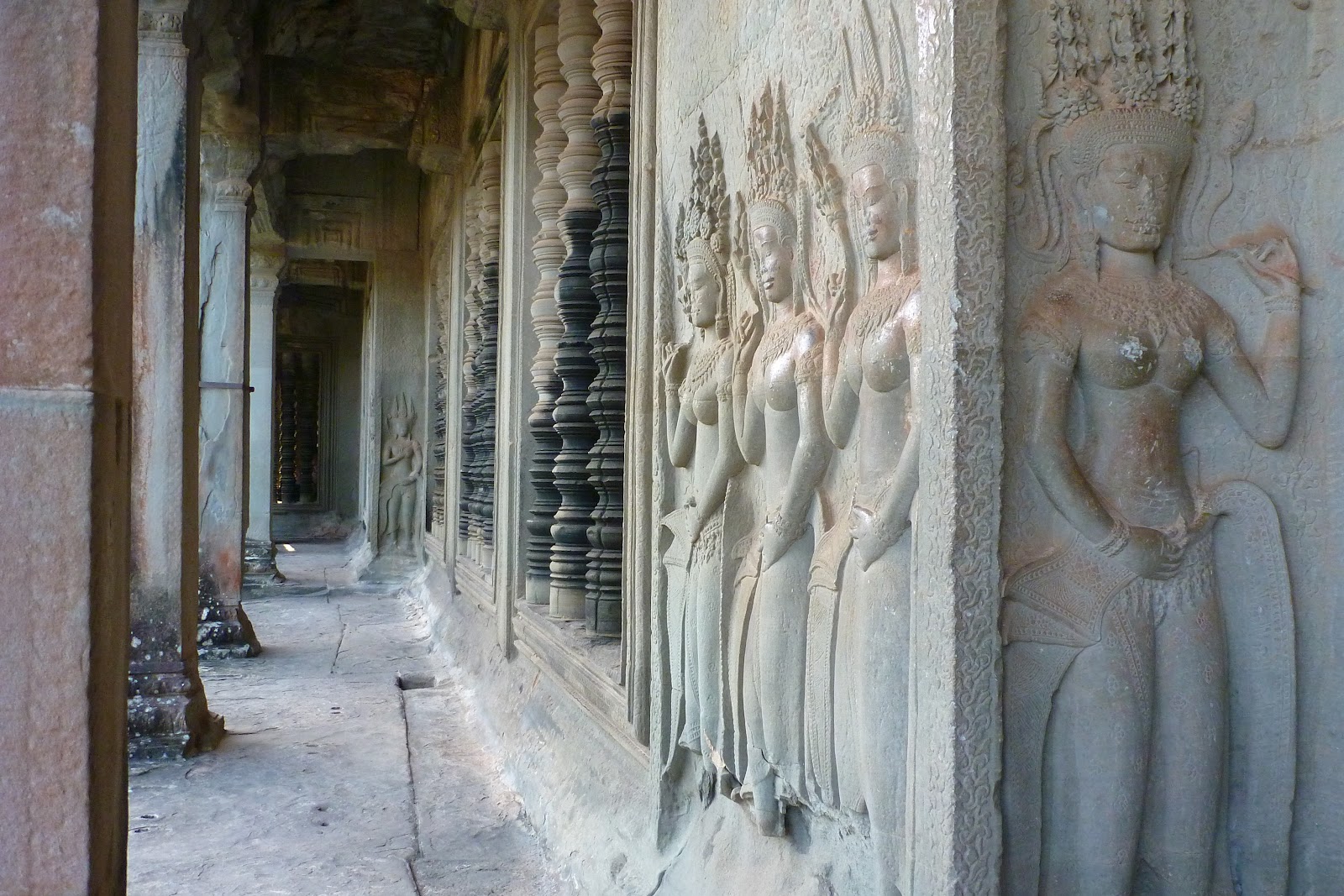
Angkor Wat is obviously the famous star of Cambodia and the reason so many tourists started to visit the country. I begin my visit before sunrise and watch as the sky turns red and the sun rises behind the profile of Angkor Wat's stunning towers, casting its shadow into the lily pond in front. I get to wander round the rest of the temple with it relatively deserted which is great for photos and the atmosphere. The experience is all the better for the serenity of the early morning. Angkor Wat is grand and majestic. It towers over the land a statement of superiority. It's mighty form is offset by intricate detailed carvings in it's interior which invoke sentiments of appreciation for its delicate beauty.
This is not an exhaustive description of the sights I visited; that would bore you, merely a selection of the highlights but nothing to compare with seeing the temples themselves. If you ever have the opportunity, take it.

Monday, 9 April 2012

Travel by Boat; Battambang to Siem Reap

Regardless of many bad internet comments and in spite of the hotel clerk doing his best to dissuade us, we've decided to take the boat trip from Battambang to get to Siem Reap as it's supposed to be very scenic, although in the dry season it can take up to 12 hours and the bus only takes 3 (and costs less). At 7am we're informed it's a particularly crappy plastic boat that's operating today and indeed it is but it'll do the job. The onboard toilet however is well below our pompous standards, consisting of 4 walls 3 ½ feet tall surrounding a hole in the floor, yes, no roof, so the men sitting behind will see you doing your business! Err won't be using that then! It is a very beautiful trip up the river, passing rural villages where life revolves around the river and the land. Some people have floating houses on the water or live in boats and others live on it's banks. We pass by an entire floating village on the lake near Siem Reap which is quite a sight. Arriving in Siem Reap at 3pm were pleasantly surprised we're already there! Not a bad 8 hour journey at all, quite pleasant.

Saturday, 7 April 2012

Battambang Bamboo Train

If you're stopping by in Battambang take a trip to the Bamboo Train. Also known as the 'Nori' Battambang's bamboo train is situated 15kilometres outside the city, it's a pretty drive through the countryside and on arrival we pay $5 each for a ride on one of the little 'carriages'. It's a normal looking train track but the trains are simply two axels with wheels, a bamboo platform and a motor sitting on top!
We sit on the wooden mat and whizz down the line, the fresh countryside wind in our hair, surrounded by views of rice fields and grazing cattle. There's only one line and trains run in both directions so when you come face to face with another carriage one of you has to offload and dismantle the simple train to allow the other to pass. It's actually great fun. We stop some way down the line at a small village where lots of smiley children are keen to show us around the brick making factory there. After following the kids around for a bit and practicing their English we grab a drink at one of the villager's stalls. She's a lovely friendly lady who makes us rings out of leaves and high-fives us with a big smile before seeing us back off down the line. The sun is rapidly falling in the sky and it's a beautiful scene as we chug and rattle along the lines which are pretty bent and warped all the way along. Well worth the $5. See for yourself.

I spend my other day in Battambang visiting some temples and caves and temple caves; beginning with a climb up 358 steps to the ruins of Angkorian temple Banan. Marvelously carved stones are crumbling from the 5 stupas which feel authentically ancient and are very beautiful. The surrounding cactus plants make for quite a scene, coupled with the hilltop view it makes it worth the climb up the steps. After Banan temple I visit Phnom Sampeou which is set a-top a rather tall hill that has to be walked up, well if you're lazy you can hire a moto. On the way up I explore a cave which now contains a shrine and reclining Bhudda but in the times of Pol Pot this place was used like the killing fields. Innocents murdered above and their bodies thrown into the pit of the cave. The bones have been displayed here inside a glass shrine. After a very sweaty climb I make it to the top of the temple and am rewarded with a stunning view across the landscape. The land is so flat you can almost see past the horizon! That concludes my sightseeing of Battambang.

Phnom Penh; The Killing Fields


The Choeng Ek killing fields are situated 15 kilometres outside of Phnom Penh and are so named because it is basically a field where the Khmer Rouge brought people, including prisoners from S21, to slaughter them. It was an execution ground. I begin my visit in a small museum where I read about the atrocity of the Khmer Rouge and watch a short informative video. The rest of the site is navigated with the narration of an audio guide. It takes me through the green field which is shaded by beautiful flowering trees and bordered by an orchard. Its hard to imagine at first the bloodshed that occurred in this pretty setting but the audio guide gives a moving and graphically descriptive portrait of events, including stories from survivors of the regime who lost dearly loved ones to it's whim.
There are hollows in the ground where mass graves have been excavated. One contained 450 bodies, one 160 headless corpses, one only women and children. Most victims were killed as soon as they arrived at Choeng Ek but some were detained overnight. Nearly all were bludgeoned to death and had their throats slit before their bleeding bodies were pushed into the dug pits. A mournful tree stands next to one of the excavated graves; the children's grave. The tree was used to smash the innocents heads against, breaking their skulls before they were tossed into the heap of bodies. A vivid description is given by the man who discovered the tree after the fall of Phnom Penh. He tells how he saw the trunk of the tree was covered in blood, hair and brains and soon deduced what might have happened.
It's a tear-inducing walk around the site where clothing and bones still rise from the disturbed earth. I see rags in the dirt alongside a partially uncovered jaw bone. The bones from the excavated graves were cleaned and are now housed in a memorial stupa in the centre of the site. It's a rather morbid sight and I'm not sure it isn't a bit disrespectful to the families of the victims to display them in this way. I only hope it's been done to emphasize the cruelty and atrocity that was the Khmer Rouge and not simply to attract tourists. Cambodians believe that the souls of people who don't receive a proper burial will not be able to pass on and will be left wandering in the ether of this world. I hope the souls from this land have been able to find peace and pass on to their afterlife.

Wednesday, 4 April 2012

Phnom Penh, Tuol Sleng Genocide Museum; S21

Cambodia has a horrific modern history from the 1970's when for almost 4 years the Kampuchea Democratic Party overthrew the government in power and turned the country into a huge slave labour camp. They evacuated the cities and marched everyone into the countryside, to the rice fields where they undertook hard labour for nothing and received only a little food each day. The regime, known more widely as the Khmer Rouge, killed thousands of people, actually 2 million in total, for no valid reasons; because they were too educated, because their hands were too soft, because they were starving and stole food, women, children; no one was safe. They killed indiscriminately; even their own soldiers who they deemed to have not been carrying out their duties properly.
The Tuol Sleng Genocide museum is housed in some concrete buildings in a compound which used to be a high school, but under Khmer Rouge rule it was turned into a security prison; S21 where arrested civilians and soldiers were brought and tortured until they confessed to something the Khmer Rouge deemed to be a crime. After confessing to even the most petty of 'crimes' most were taken away and brutally slaughtered. If they didn't lie and confess to something they probably hadn't even done they continued to endure the cruelest of tortures, and when they confessed their only escape was into death. Many died at S21 from wounds inflicted by their torturers, alone and destroyed in a pool of blood.
I walk through the buildings haunted by the ghosts of its victims. Some rooms are filled with mug-shots of the inmates and victims, each face tells a story, expressions of anger, desperation, stubborn bravery, fear, complete and utter sadness, nothing. I see tears in the eyes of babies, defiance in the eyes of young men and a complete loss of hope in the eyes of mothers. It's a horrifying place where the exhibits tell stories of the people who were sent here, the people who committed the terrible torture acts and the leaders of the dictatorship regime; some of whom died before any justice was brought was brought to their heads. I walk through one building where rough brick walls were constructed to make tiny individual cells to detain victims in. Upstairs a similar layout is created with wooden partitions but solid doors create an even darker claustrophobic atmosphere. I can feel the presence of those who suffered so much here. Their sadness lingers in the air, a sense of death hangs over the horrifying complex.
Bones and skulls of someone's loved ones are displayed in cabinets, unidentified, lost. On the floor above hate filled visitors have scratched out the faces on photographs of the atrocious Khmer Rouge leaders, wanting for justice to be brought to the perpetrators who caused so much pain and suffering and exterminated one quarter of Cambodia's population; mothers, brothers, lawyers, doctors, sons, teachers and daughters. They were the most brutal regime and the museum truly brings to light the atrocities they committed.