Cambodia has a horrific modern history from the 1970's when for almost 4 years the Kampuchea Democratic Party overthrew the government in power and turned the country into a huge slave labour camp. They evacuated the cities and marched everyone into the countryside, to the rice fields where they undertook hard labour for nothing and received only a little food each day. The regime, known more widely as the Khmer Rouge, killed thousands of people, actually 2 million in total, for no valid reasons; because they were too educated, because their hands were too soft, because they were starving and stole food, women, children; no one was safe. They killed indiscriminately; even their own soldiers who they deemed to have not been carrying out their duties properly.
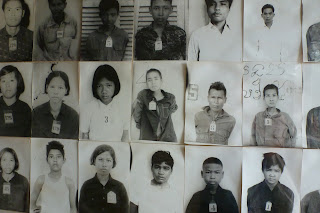
The Tuol Sleng Genocide museum is housed in some concrete buildings in a compound which used to be a high school, but under Khmer Rouge rule it was turned into a security prison; S21 where arrested civilians and soldiers were brought and tortured until they confessed to something the Khmer Rouge deemed to be a crime. After confessing to even the most petty of 'crimes' most were taken away and brutally slaughtered. If they didn't lie and confess to something they probably hadn't even done they continued to endure the cruelest of tortures, and when they confessed their only escape was into death. Many died at S21 from wounds inflicted by their torturers, alone and destroyed in a pool of blood.

I walk through the buildings haunted by the ghosts of its victims. Some rooms are filled with mug-shots of the inmates and victims, each face tells a story, expressions of anger, desperation, stubborn bravery, fear, complete and utter sadness, nothing. I see tears in the eyes of babies, defiance in the eyes of young men and a complete loss of hope in the eyes of mothers. It's a horrifying place where the exhibits tell stories of the people who were sent here, the people who committed the terrible torture acts and the leaders of the dictatorship regime; some of whom died before any justice was brought was brought to their heads. I walk through one building where rough brick walls were constructed to make tiny individual cells to detain victims in. Upstairs a similar layout is created with wooden partitions but solid doors create an even darker claustrophobic atmosphere. I can feel the presence of those who suffered so much here. Their sadness lingers in the air, a sense of death hangs over the horrifying complex.

Bones and skulls of someone's loved ones are displayed in cabinets, unidentified, lost. On the floor above hate filled visitors have scratched out the faces on photographs of the atrocious Khmer Rouge leaders, wanting for justice to be brought to the perpetrators who caused so much pain and suffering and exterminated one quarter of Cambodia's population; mothers, brothers, lawyers, doctors, sons, teachers and daughters. They were the most brutal regime and the museum truly brings to light the atrocities they committed.


 I spend my other day in Battambang visiting some temples and caves and temple caves; beginning with a climb up 358 steps to the ruins of Angkorian temple Banan. Marvelously carved stones are crumbling from the 5 stupas which feel authentically ancient and are very beautiful. The surrounding cactus plants make for quite a scene, coupled with the hilltop view it makes it worth the climb up the steps. After Banan temple I visit Phnom Sampeou which is set a-top a rather tall hill that has to be walked up, well if you're lazy you can hire a moto. On the way up I explore a cave which now contains a shrine and reclining Bhudda but in the times of Pol Pot this place was used like the killing fields. Innocents murdered above and their bodies thrown into the pit of the cave. The bones have been displayed here inside a glass shrine. After a very sweaty climb I make it to the top of the temple and am rewarded with a stunning view across the landscape. The land is so flat you can almost see past the horizon! That concludes my sightseeing of Battambang.


